Friday, August 15, 2014

Revised History of HIV in Kenya – Part IV - Diversity

Why is HIV spread so unevenly? In some parts of Kenya prevalence is at 'hyperendemic' levels, over 20%, almost 30% in one county. Yet in other counties it is low, 1% or lower. If, as we are constantly told, 80%, even 90% of HIV transmission is a result of unsafe sex (most of the remaining 10-20% being a result of mother to child transmission), what amazing sex lives people in some counties must have (or disgraceful, if you prefer). And what dull (or worthy) lives those in other counties must have, apparently only having sex for the purpose of procreation.
If, on the other hand, HIV is not always a result of sexual behavior, if many people may be infected through unsafe healthcare, even unsafe cosmetic and certain traditional practices, some of the factors involved in HIV transmission rates, low or high, start to make a lot more sense. The list of factors is long (over 40), but the italicized paragraphs are the kind of explanations given by the 'it's all about sex' camp, so they are mostly the same. Yes, some HIV transmission is a result of sexual behavior, nobody is denying that, but some is not. Also, some areas where HIV transmission is high are in need of further study; a priori explanations for high and low prevalence have no place in science (though they seem to receive a warm welcome in a lot of papers on HIV epidemiology).
Christian
Prevalence is often higher among Christians than Muslims, and generally among males than females; not sure why this is so; the majority of HIV positive people in the world live in predominantly Christian countries, meaning that a lot more Christians than non-Christians are infected; why this is so is not clear, although both healthcare access and HIV prevalence are noticeably low in some Muslim dominated countries
Men less likely to be circumcised; also Christians are 'less restrained' in their sexual behavior than Muslims
Circumcision
There is no clear evidence that circumcision reduces HIV transmission and it could only influence sexual transmission, at best; however circumcision is risky if carried out in unsafe healthcare facilities or in traditional settings
Circumcision 'cleaner' or 'more hygienic', although this is a hypothesis, there is no unambiguous evidence
Colonization
The vast majority of HIV positive people live in countries that were colonized by the British. This may relate to healthcare facilities, access to healthcare, health seeking behavior, infrastructure, stability, etc
It's somehow related to sex
Condom use
HIV prevalence is higher, often far higher, among people who sometimes use condoms than among those who never do, suggesting that HIV risk is not always sexual
Those who are already infected are more likely to use condoms
Culture
Cultural practices such as female genital mutilation (FGM) may increase the risk of being infected, although it increases both sexual and non-sexual risks; yet prevalence among people who practice FGM is generally low, which suggests that there are other factors involved
Increases HIV transmission; if prevalence is low this can be explained away by reference to attitudes towards extra-marital sex, etc
Depo Provera
Increased risk for women taking it and for their partners
Denies that this is a risk and claims that the benefits (prevent conception) outweigh any disbenefits, which don't exist anyway
Education
Educated people may have better access to healthcare and be more likely to use healthcare
Educated people have access to bigger sexual networks
Employment status
People with a job can afford healthcare, although this may not be safe healthcare; jobs may include healthcare or health insurance; some occupations provide healthcare services;
People with a job have more money and therefore access to bigger sexual networks; despite prevalence generally being higher among employed people, some suggest that unemployed people have little else to do but have sex
Female
Prevalence is usually higher among women, possibly because they have more need to use healthcare services, especially when pregnant and giving birth; they are also more susceptible to sexual transmission
Women are more vulnerable and have less power to make choices; they are usually victims, otherwise they fall under one of the many categories of sex worker
Fertility
Higher fertility may increase healthcare exposure, although it is often associated with low prevalence areas, rural areas, etc
Higher fertility means more unprotected sex
Healthcare
Healthcare may not always be safe, which may explain why countries with good access to healthcare for everyone, such as Botswana, may result in higher HIV prevalence
Sick people, including people with HIV, seek healthcare, which is why healthcare may seem to be associated with higher HIV prevalence; this is especially true of STIs
Hepatitis
HBV and HCV are much more likely to be transmitted through non-sexual routes, such as unsafe healthcare, cosmetic and traditional practices, also injection drug use
Presence of HBV and/or HCV are signs that the person is either promiscuous or an intravenous drug user (or both)
Herpes
Rates can be extremely high in some populations because it is very easy to transmit, sexually and through other routes; it plays a role in being infected with and transmitting HIV but the role is complex
It is a sign that people infected engage in unsafe sex and increases risk of transmitting and being infected with HIV
Inequality
It is neither clear that inequality is associated with higher risk, nor why this may be so
People are more vulnerable to sexual risk, especially women
Infrastructure
Good infrastructure is often associated with high HIV prevalence, which may suggest better access to unsafe healthcare
Good infrastructure gives access to bigger sexual networks
Male
Prevalence is usually lower among men than women, which leaves a question mark over instances of higher prevalence among men when they are found, for example, Muslim men in Kenya; prevalence may be lower because of lower use of health facilities
Men are considered to be mere spreaders of sexually transmitted disease, whether they are rich or poor, urban or rural dwelling, etc
Marriage
Sometimes HIV prevalence is far higher among married than unmarried people and it is not clear why
Married people are less likely to use condoms; they also have extra marital sex, usually the men, then they go home and infect their spouse
Migration
Migration can be for work, which may involve work-related healthcare, which may be unsafe and may not be subject to levels of scrutiny faced by public facilities, however scrutinized  they may be
Migrants, being away from home, either have other sexual partners or visit sex workers; they then return home to infect their spouse
Mobility
Possibly increases access to health facilities, but mobility on it's own doesn't seem to explain high prevalence
Mobile people have access to bigger sexual networks
Muslim
Figures vary, with prevalence higher among Muslims than Christians in some countries (eg, Burundi, Rwanda, Mozambique, but not Kenya or Tanzania), also higher among Muslim men than women in others, eg Kenya; not sure why this is so
Men more likely to be circumcised; also Muslims are 'more restrained' in their sexual behavior than Christians
National borders
High HIV prevalence has been reported at border areas in the past and rates of unsafe sexual behavior may be higher; but the sex workers and long distance drivers who are said to be responsible for high rates have often taken part in STI eradication programs and may frequently use STI clinics
Long distance drivers have sex with sex workers, then they go home and have sex with their spouses
Occupation - armed forces
Members are unlikely to have any option as to whether they take part in various health programs, tests, etc; healthcare is likely to be free, which means usage is also probably higher
They have access to bigger sexual networks and frequently visit sex workers
Occupation - fishing
Prevalence is high in fishing communities, not necessarily highest among the fishermen; also, very high prevalence seems to be a feature of only some fishing communities, especially lakes; not sure why HIV prevalence is so high
Fishermen do risky work, therefore they are not bothered by sexual risk; also, they spend a lot of time away from home; also, they use sex as a bargaining tool
Occupation - mining
Artisanal mining is not so much associated with HIV so this probably applies to industrial scale mining; the work-related healthcare to which miners have access (they may even be compelled to receive certain health services and tests) may not be safe
Miners work a long way from home and don't see their family much so they have extra-marital relationships and/or visit sex workers, then go home and infect their spouses
Occupation - teaching
Prevalence has been claimed to be higher and lower among teachers, at different times and places; they probably face similar risks to other public sector employees, whatever those may be
Teachers frequently have sex with their pupils (which may be true, and should be addressed, but it may turn out to have little to do with HIV transmission)
Occupation - transport
Transport workers may use health facilities more; also, they may have been persuaded to take part in STI eradication programs as they have been blamed for all sorts of things; these STI programs may not always have been safe
Transport workers are mobile, which means they have access to bigger sexual networks; then they go home and infect their spouses
Polygamy
Sometimes associated with higher transmission, sometimes with lower transmission, therefore not clear. It is not only practiced by Muslims but also by some tribes and even at least one Christian sect in Kenya
When prevalence is higher, this is because polygamy involves 'concurrency'; when lower, it's because men with more than one wife don't need to have extra-marital sex, or not as much
Population density
Increases pressure on health facilities
Said to increase the size of sexual networks
Population growth
Increases pressure on health facilities
Said to increase the size of sexual networks
Poverty
HIV prevalence is often lower among poorer people, suggesting that they may face lower risk from, for example, unsafe healthcare because of reduced access; however, being poorer means that the only healthcare available may be unsafe
If prevalence is high, poorer women are more vulnerable (to sexual transmission) for various reasons;  if it's lower, poorer people are less likely to be part of a 'sexual network’ or their networks are likely to be smaller
Prisoners
There may be some kind of drug use that involves cutting or skin piercing (seems unlikely injection drug use would be common); healthcare is unlikely to be very comprehensive or safe; tattooing and traditional medicine may be additional risks, perhaps also scarification, blood oaths, etc
They have sex with other prisoners, the implication being that the sex includes anal sex; and/or injected drugs or drugs that involve skin piercing; condoms are usually not permitted
Rural
Rural dwelling people have less access to health facilities and infrastructure, which may go some way to explaining why prevalence is usually lower in rural areas
Rural dwelling people have access to smaller sexual networks
Schistosomiasis
This has been shown to increase susceptibility to infection and onward infection, which suggests that some people have sex, not very surprising; but endemic schistosomiasis, which is very cheap to treat, suggests weak healthcare systems
Lots of people having lots of sex with lots of other people all the time: schistosomiasis only adds to what is a 'known issue'
Sex work
Prevalence among sex workers is low among some sex workers in Western countries unless they also engage in injection drug use but their biggest risk in countries with unsafe healthcare could be their frequent exposure to STI clinics and STI eradication programs; also, a lot of what is referred to as 'sex work' is in fact sex between people who are in a relationship or married; many people who are related, in a relationship or married also do business with their partner or relative; 'gift giving' is sometimes said to be a form of 'transaction' between two people who have sex; this is a very stigmatizing use of the term 'sex work' (a bit like the term 'orphan', which refers to children in developed countries who have lost both parents, but children who have lost one parent in developing countries; or the word 'trafficking' which seems to refer to just about anything that involves sex and that can attract funding to 'rescue victims' from)
Sex workers are forced into sex work by poverty, powerlessness, vulnerability, etc, but their consequent risks are high and entirely sexual, unless they are also injection drug users
STIs
STIs do not only suggest unsafe sexual behavior, they also suggest a health system that is failing; some are also transmitted through non-sexual routes, such as herpes and HIV
STIs are a sign that a person engages in unsafe sex
TB
TB is likely to be an occupational disease in deep mines, though mining operations deny this, as they don't want to compensate those who contract it, pay for their treatment or improve conditions in mines; it increases HIV transmission in both directions
HIV positive people are more susceptible to TB
Tribe
Prevalence is high in some tribes and low in others (high among Luos, low among Somalis in Kenya, for example), which suggests that there may be several factors involved; there are 'risky' practices in tribal groups among whom HIV prevalence is low, as well as high (for example, female genital mutilation, which is widespread among Somalis)
'Tribal' practices and/or 'traditional' practices can be wheeled out on any occasion, either to explain high prevalence or low prevalence; they often involve sex or some form of brutality an are generally inflicted by men on women
Urban
Urban dwelling people have easier access to health facilities and other infrastructure
Urban dwelling people have access to bigger sexual networks
War/civil conflict/refugee camps
Prevalence is generally low during wars and only increases after the war has finished, perhaps because health seeking behavior changes during wars, health facilities become less accessible, money is short, infrastructure is destroyed, etc
If HIV is transmitted it is because people take advantage of the situation, rape and other forms of sexual violence being common; but as prevalence is usually lower it is claimed that sexual networks become smaller, people return to rural areas, etc
Wealth
Prevalence is often higher among wealthier people, suggesting that they may use healthcare more frequently; they may also face occupation related risks that are also non-sexual
Wealthy people can become part of larger sexual networks; they have more opportunities for sex and are more likely to avail of these opportunities
Widowhood
Prevalence among widows and widowers can be very high but it is not clear why
Widows are, in some cultures, inherited, having been widowed because their husband (obviously) died of AIDS; they are 'cleansed' (have sex with their inheritor) who may be the brother of the deceased, and infect him; he goes on to infect his other partners, including his spouse
The list above makes no claim to be exhaustive. When there is so much diversity in HIV epidemics within and between countries, why would anyone conclude that almost every factor is, ultimately, a matter of sexual behavior, or somehow relates to sexual transmission? It's no wonder, given the above list, that HIV positive people are feared, even despised. It is the view that transmission is almost always sexual that results in the stigma UNAIDS and other institutions claim to abhor and pretend to be fighting; they are the source of the stigma. HIV 'prevention' programs that include some or all of the italicized arguments above merely spread the stigma.

allvoices

Thursday, August 14, 2014

Revised History of HIV in Kenya – Part III - Chronology

I mentioned some historical factors in Part II, so I’ve put together a timeline for Kenya’s epidemic, which seems appropriate in a history, especially a quick and dirty one. Some of the factors involved in HIV epidemic spread date back to the beginning of the century (or the beginning of humanity in the case of population). The table only lists some factors that have played, or are said to have played, a significant role; others will crop up later.
HIV Timeline Kenya
[Click on image to expand]
These factors would not have made it in any way inevitable that HIV would spread rapidly in certain places, more slowly in others and hardly at all in a few. That’s not what I’m arguing here. But there is an exception, a factor which doesn’t yet appear in the above table. Unsafe healthcare facilities to which the majority of a population has access render outbreaks of certain diseases more likely, and probably facilitate the exponential growth of some of those diseases more efficiently than any other factor possibly could. This is not true for HIV alone (or even MRSA in wealthy countries). TB can spread in health facilities (though deep mines are likely to be far more notorious in this instance), as seen in the case of Tugela Ferry in South Africa. Hepatitis C (and B) has often been spread widely through public health programs, such as in Egypt. Ebola is also very easily spread this way, and early accounts from some outbreaks are fairly explicit about this. Many of the people infected in the current outbreak are healthcare personnel. Many more were likely to have been infected by contact with other infected people in health facilities, perhaps even through contact with doctors and nurses (either because the doctors or nurses were infected or because their protective clothing was contaminated). Unsafe healthcare, as mentioned in Part II, is said to have ‘kickstarted’ the HIV epidemic. But conditions in healthcare facilities in African hospitals are appalling, so unsafe that the UN warns its employees not to use them. Tourists are warned to avoid injections and other procedures, even to carry their own injecting equipment. It’s only Africans themselves who are urged to go to health facilities and public health programs, without any warnings about unsafe practices or risks.
What is inevitable is that, if there is ever an outbreak of a disease that can be spread through unsafe healthcare, it will result in a serious epidemic in countries where conditions in healthcare facilities are unsafe. Such outbreaks have been documented in the case of HIV in Libya, Kazakhstan, Kyrgyzstan, Romania and other countries. But the possibility of such outbreaks in sub-Saharan African health facilities has not been investigated. Or, if such an occurrence has been investigated, the findings have never been published.
So there were political, economic, environmental, ecological, demographic and various other factors in play long before HIV first reached Kenya, said to be some time in the 1950s. They are briefly mentioned in the above table because they need to be explained, which requires some historical detail (more than a superficial account is beyond the scope of this post). Therefore, I shall jump to the end of the colonial period right now and address remaining issues another time.
The first 10 or 15 years of independence saw a lot of progress in Kenya, especially in education and healthcare. Spending increased to provide these and other services for everyone, rather than the select few who would have had access to them before independence. The relative prosperity of this period was short lived. Global and more local economic and political events in the 1970s and 1980s would have already begun to interrupt progress. But the need to accept loans from the World Bank and the IMF, which had strict ‘austerity’ conditions attached to them, spelled the end of improved access to health and education, cuts in all public spending, wage freezes, spiraling unemployment and a severely reduced public sector, including health and education, which are among the biggest employers.
In 1978 Moi took over from Kenyatta, the first president after independence, and was happy to comply with the stringent conditions demanded by these international financial institutions through their structural adjustment policies, as long as it meant he could get his hands on a lot of money. He remained president for 26 years, during which time the population went from 16 million to about double that figure, while health, education, infrastructure and other sectors were held, nominally, at around 1980s levels, although these sectors declined rapidly during the Moi regime.
This is where the story becomes surprising (if you think it's all about sex). HIV had been around for a few decades, albeit unnoticed. But it spread rapidly from some time in the 80s and prevalence probably peaked in the late 90s, at 10 or 11%. Very high death rates, peaking in the early to mid 2000s, helped ensure that prevalence was halved by 2012 or 2013, according to the latest figures (although that’s 5% of a population that is increasing at over 2.5% per annum). But why would HIV prevalence decline when the worst effects of structural adjustment policies were being felt, from early in the 1990s onward, as it appears from my (admittedly rough) chronology? The annual rate of new infections, incidence, is said to have peaked in the early 90s, which would account for a peak in prevalence a few years later, and a subsequent drop. But we associate increased levels of spending on health, education, infrastructure and the like on development, better education, and better levels of health. How could the epidemic appear to be receding at precisely this time? The country had done nothing to deserve improvement in any area of health, let alone HIV, which Moi refused to acknowledge for most of his term of office.
When I wrote the brief account of HIV in Kenya five years ago, I was still busy questioning some of the completely unexpected findings I had uncovered for my dissertation, most or all of which the HIV industry was already aware. Why were wealthier people often more likely to be infected? Why were urban dwelling people also more likely? Why were ‘unsafe’ sexual behaviors often little more associated with HIV transmission than an absence of such behaviors, or the presence of ‘safe’ sexual behaviors? In Kenya, almost all development indicators were at their lowest in the Northeastern province, but HIV prevalence was also lowest there. Condom use was minimal, fertility rates were high even for Kenya, gender inequality was high, polygamy was common, as was female genital mutilation, intergenerational sex and marriage (large differences in age between partners, usually older men and younger women) were far more common than anywhere else in the country, and many people had little knowledge of HIV.
The list continues. Population was growing rapidly in some of these areas, several were undergoing urbanization (or something similar) and population density was increasing in others. Shortly after I started studying HIV it was clear to me that it couldn’t possibly be all about heterosexual behavior, I just didn’t know what could account for very high prevalence figures in some places and low figures in others. Upon visiting Kenya in 2002, when everyone told me about ‘traditional’ practices and all manner of factors that resulted in high rates of HIV transmission, they were also talking about how ‘abstaining’ (a word I associated with religion), ‘faithfulness’ (a word I associated with courtly love) and ‘condomizing’, a word I didn’t associate with anything at all, were resulting in declining prevalence figures. How could this be, and weren’t high death rates already explaining these drops in prevalence?
Obliged to exclude certain modes of HIV transmission from my dissertation to keep it focused and within size restrictions, I was advised to lose sections on non-sexual HIV transmission. It took me a about a year to get back to that, but when I did, all the previously unexpected findings started to make sense: I was sure that HIV wasn’t solely transmitted through sex, I just didn’t know that the HIV industry had been so strenuously denying the proportion that unsafe healthcare, cosmetic and traditional practices had been contributing in the past, and were still, obviously, contributing. It became clear that the industry somehow resembled an old boy network infused with a kind of freemasonry, a fair amount of evangelical zeal, and a good helping of neo-eugenicism acquired from some of the big NGOs that got in on the HIV act early on.
HIV is transmitted through heterosexual sex, that’s not in question. But people in Northeastern province don’t have much access to healthcare, infrastructure, education or many other benefits, and that is what may have protected people living in that province from HIV. In contrast, people living close to better developed infrastructures, people in cities (especially Nairobi, Mombasa and Kisumu), wealthier people and people living closest to health facilities may have, where conditions in health facilities were not adequate, faced very high risks. They are not ‘at risk’ populations, so much as ‘populations put at risk’ by the institutions that persuade them to avail of their services but can’t always provide these services safely. There are, indeed, certain behaviors that increase the risk of being infected with HIV, but they are not all sexual behaviors, they are not all individual behaviors and they are not all the behaviors of poor, uneducated, powerless people, either.
It’s not that health, education and infrastructure are not benefits, they are. Kenyans and people of all underdeveloped countries need more healthcare, more education and more (appropriate) infrastructure, lots more than they have ever had. But unsafe healthcare can be a lot worse than no healthcare. When structural adjustment policies reduced access to the benefits of health, education and others, they may also have reduced the exposure of most people in Kenya to an important, but rarely discussed, HIV risk.
An estimated 1.6 million people are living with HIV today, but that’s a relatively small percentage of the population. HIV prevalence in countries with far better and more equitable access to health facilities, such as Botswana, is among the highest three in the world. The HIV region where the epidemic is said to have begun, with relatively poor infrastructure, also has a far less serious epidemic than the southern region. Where road networks are almost entirely absent, such as in the Northeastern province of Kenya (and some countries in low prevalence North Africa), there are few health facilities, and access to these facilities is low. But along Kenya’s best road networks (which are certainly nothing to boast about) HIV prevalence is higher. The best health facilities are not found in isolated areas, of course. But nor are the best health facilities likely to have been safe places in the 1980s and 1990s. Some of them are still unsafe, we just don’t know how unsafe, and exactly what proportion of HIV is transmitted through unsafe healthcare.
Infrastructure alone didn’t result in rapid transmission of HIV, much of that was built during the colonial period. Nor did the existence of health facilities, or even public health programs, guarantee that a HIV epidemic would be severe. But increased access to health facilities where safety standards sometimes (often?) fell below par might explain the huge increases in HIV prevalence that occurred inside very short periods. People outside of the HIV industry would wonder how a virus that is difficult to transmit through heterosexual sex could appear ti occur in ‘explosive’ outbreaks, with prevalence doubling in less than a year. The industry would assure them that ‘Africans’ clearly engage in levels of unsafe sex that is beyond what any non-Africans could manage. Those whose prejudices already matched those of the HIV institutions accepted this explanation. Anyone who continued to question such a racist view of HIV was accused of denialism and shunned by their professional colleagues (unless they didn’t have any professional colleagues, or a profession).
Much of the evidence collected over the last 30 years, even evidence collected by the HIV industry itself, points to a rule of thumb: you can not work out levels of sexual behavior from HIV prevalence; and you can not work out HIV prevalence from levels of sexual behavior. But the HIV industry, outrageously, insist that high HIV prevalence in African countries is evidence for high rates of 'unsafe' sexual behavior, and  that high rates of sexual behavior ‘explain’ or predict high rates of transmission.
When I turned my attention to non-sexual HIV transmission I came by a small group of people who are still questioning the orthodoxy, as they had been doing for many years. Some have retired, others don’t depend on HIV related funding for their work, most are doing it for free. There are those who had been involved in HIV related work, and they are either ignored or treated with contempt for even talking about unsafe healthcare, or anything else that makes the sexual behavior paradigm look like the institutional racism that it is. The mere mention of some names involved can end a conversation, or elicit  no more than a peremptory gesture, which is the only evidence the HIV industry has yet been able to muster against the possibility that non-sexual modes of transmission may make a significant contribution to the most severe HIV epidemics in Africa.
In Kenya, people will still tell you about how much ‘Africans’ love sex. If you ask why prevalence in Homa Bay, bordering on Lake Victoria, is 135 times higher than it is in Wajir, not far from the border with Somalia (though not very close to anything else worth speaking of), they will say that people around Lake Victoria love sex. Beyond that, they have no credible explanation. Every now and again there’s a flurry of activity around some issue that attracts the media’s attention and this can crop up in conversations. For example, in 2002 some people were still talking about ‘devil worship’, for which a well publicized commission was set up, and which never published the results of its inquiries. But HIV stories drowned out even stories as titillating as devil worship. People around Lake Victoria will tell you with great relish about the sexual behaviors of fishermen, ‘barmaids’, transport personnel, Ugandans, Luos (the predominant tribe around Lake Victoria) and various other groups that have at various times been held up for scrutiny by the HIV industry and, as a result, thoroughly stigmatized.
HIV has been in Kenya since just after the middle of the 20th century and it was recognized from the early 1980s. It has spread around the country, though very unevenly, perhaps over a period of 40 years. The HIV industry has convinced Kenyans that it is individual sexual behavior that ‘spreads’ HIV. But transmission rates declined before any effort was made to address the epidemic, something the HIV industry are unable to explain. So the epidemic is still very much alive, and unexplained by the orthodox story. Kenyans still don’t know what is driving the epidemic, therefore they don’t know how to prevent it from continuing.
There’s more, a lot more. Hopefully I’ll have time soon.

allvoices

Tuesday, August 12, 2014

Revised History of HIV in Kenya – Part II - Spaces and Times

It might sound reasonable to start a history of a virus that was only identified in the 1980s in the same decade, or perhaps the decade before, just to be safe. But many of the phenomena that are said to be involved in the HIV pandemic go back a long way. There’s no need for me to start with the earliest known historical accounts, nor even with the time the virus ‘jumped species’, from chimps to humans. That history has been well described elsewhere. But I have chosen to start at around the beginning of the 20th century for several reasons.
HIV itself can be dated to the early part of the century using genetic dating techniques, for one thing. But also, Britain had established Kenya as a protectorate in 1895. Christianity was already on the way to becoming the predominant religion (although there had been Christian Kenyans for several hundred years). Nairobi and other cities were only ‘trading posts’, but some of them eventually became heavily (and densely) populated. Several of the most important exports in Kenya today were already significant parts of the economy many decades ago. Even international social, health, educational and financial institutions that were eventually to play an important (though by no means always positive) role in Kenya’s development have been around for over half a century. Some environmental and ecological issues that only came to a head later had already begun, and much of the country’s current infrastructure was developed early on in the British occupation, to facilitate the extraction of resources, move large numbers of workers and soldiers around, etc.
I think it will become apparent why these issues are worth looking at. There is a potentially huge list of other issues that may be relevant, but I’m concentrating on the ones that I believe are in need of greater attention. Most official accounts of HIV epidemics, from the likes of the WHO, UNAIDS and others, obsess about labels, various ‘vulnerable’ groups, specific populations said to exemplify certain kinds of behavior (almost always sexual and generally presented as somehow illicit or ‘deviant’), people engaged in certain occupations and others. Examples from UNAIDS' latest offering (The GAP Report 2013), another multi hundred page, multicolored, expensively produced document, with some well chosen photographs are: "People living with HIV, Adolescent girls and young women, Prisoners, Migrants, People who inject drugs, Sex workers, Gay men and other men who have sex with men, Transgender people, Children and pregnant women living with HIV, Displaced persons, People with disabilities [and] People aged 50 years and older"; but other groups can easily be generated, and no doubt are, as and when required.
Naturally, we are concerned about human beings, people, their health, rights, welfare and wellbeing. But people are not the one dimensional entities denoted by the labels spewed out by international institutions (‘international’ generally meaning wealthy countries). Instead, I would draw readers' attention away from these ‘populations’, which almost all African people could be shoehorned into at some time in their lives; many would fall into several. I think it is far more fruitful, as well as a lot less demeaning, to pay some attention to places, for example, large-scale mines in southern Africa, ecological zones, such as Lake Victoria, certain hospitals and facilities that provide various health related services, perhaps even places where people go for cosmetic services and even various traditional practices, such as circumcision. As mentioned, HIV prevalence is low in the North African region, higher in the East African region and highest in the southern region. There are many spatial factors, and the HIV industry does consider them sometimes, but they always view them in terms of what kinds of sexual behavior may be practiced in high HIV prevalence areas.
In his book on the origins of HIV, mainly in Francophone African countries, Jacques Pepin talks about colonial health programs, which he and others sometimes refer to as ‘well meaning’. But, like infrastructure in general, health services were probably intended to enable the smooth running of armies, mines, companies exporting raw materials, such as timber and textiles, also high value goods such as tea. In other words, these ‘benefits’ were not developed, originally, for Africans; they were for colonials, for the colonial power. Mining companies and other big employers may find it good for business to be able to treat endemic illnesses that would otherwise threaten production (just as today, some might argue, funding is provided for diseases that we think may threaten wealthy countries, which was the case with HIV, and perhaps even ebola). Occupational and other private health services, also, may not be subject to the kind of (generally fairly superficial) scrutiny potentially faced by public health services. Pepin argues that healthcare transmission was very important early on in the pandemic, before AIDS was identified and the virus causing it was discovered. But he argues in the introduction that unsafe healthcare has long ceased to be a major factor in African countries. He also argues that almost all transmission, after a certain point in history, became sexual. For him, in a sense, there was an explosion of unsafe sexual behavior, although such a phenomenon has never been empirically described (sensationalist accounts based on high transmission rates, which have been empirically described, do not show that all or most transmission is a result of sex).
Despite the popularity of HIV related PR materials pointing the finger at certain people and their sexual behaviors, disease epidemics, HIV included, are not entirely determined by what individuals do. There are important environmental factors, ‘environmental’ being a very inclusive term indeed; and there is the pathogen itself, which I have less to say about. I have been concentrating to a large extent on spatio-temporal factors of the kind hinted at above because theories about ‘populations’ don’t seem to be very helpful, in addition to being highly prejudiced. Fishermen, miners, migrants, transport workers, teachers, soldiers and various others have at some time had the finger of blame pointed at them by the HIV industry. But often, a little background reading suggests that there is something other than their individual behavior, even their sexual behavior, that relates to high HIV prevalence. For example, HIV prevalence is very high in fishing communities, but it is not clearly highest among the fishermen themselves. Some research has suggested that proximity to and contact with Lake Victoria is associated with very high prevalence, not so much the occupations or behaviors of the people infected. Sex workers in some countries are unlikely to be infected, or at least, a lot less likely than sex workers in African countries (and infections are often a result of injection drug use). Sex workers in African countries may face elevated non sexual risks, such as frequent visits to sexual health clinics, where safety may not be prioritized. Also, some early reports of high rates among transport workers, teachers and healthcare workers may not have paid much attention to non-sexual risks, or they may have exaggerated sexual risks. Even some of the figures for prevalence have been exaggerated at times.
The HIV industry does, as I have said, pay attention to some of the factors that I would argue are important. It’s just that their starting point is how various phenomena clearly relate to people’s sexual behavior, without demonstrating that HIV is almost always transmitted sexually. People close to Lake Victoria may be more susceptible to HIV because of an endemic parasite called schistosoma. This means that sexual transmission of HIV is very significant, but there is no need to impute any kind of ‘deviant’ sexual behavior or any kind of ‘traditional’ practices that may (or may not) impinge on people’s sex lives. Just ordinary sex would be enough, sex in ordinary quantities, with ordinary people. Of course there are sex workers in Africa, just as there are sex workers everywhere. There are people who have a lot of sex in Africa, just as there are such people everywhere. But most people don’t have a lot of sex, and some have none at all. Regression to the mean doesn’t cease when you reach sub-Saharan Africa and sex is one of those things that most people can’t engage in to extreme levels. Whereas it is hard to imagine a limit to the amount of money one person can earn, there are several limits to how many different people one can have sex with, what kinds of sex, how often, etc. (I’m following Nasim Taleb’s concepts of Extremistan and Mediocristan; sexual behavior is probably not susceptible to black swan events.)
To finish Part II, HIV in Kenya is not just about individual behaviors, it is also about places, such as Lake Victoria, Turkana, Nairobi and other cities, and parts of those cities. The obsession with ‘African’ sexual behavior, which seems to have started with the eugenics movement, not with the discovery of HIV on the continent, has been entirely fruitless and highly stigmatizing. But the knowledge that certain places are clearly dangerous has yet to be translated into a similar obsession with healthcare safety, education about bloodborne HIV or a bit of effort to alleviate the most urgent concerns in the lives of ordinary people.
It’s also important also to consider certain temporalities in Kenya’s HIV epidemic. Pepin and others often mention things like societal breakdowns, urbanization, rapid population growth and the like, often with the implication that these ‘obviously’ explain massive increases in unsafe sexual behavior. But societal breakdowns did not start in the 1980s, no more than sex did (or even media fantasies about ‘African’ sexuality). Some societal breakdowns, such as wars, result in very low HIV transmission (for example, Mozambique, Angola, Sierra Leone, Somalia and others). Many societies are broken down but none of these breakdowns, that I have heard of, have been shown to result in widespread levels of unsafe sexual behavior. Urbanization and high population growth, too, have occurred at many times in many places. In Kenya there have been population growth rates as high as 8 or 9% per annum during the period 1969-2009. But often these high rates of growth were in areas where HIV prevalence never went very high, such as Mandera; some places where HIV prevalence is (or was) high experienced low population growth, such as Mombasa. Kenya’s epidemic is old enough to show that factors involved in the spread of the virus go back a long way and are still extant. Those factors, whatever they are, have eluded UNAIDS, WHO, CDC and other august institutions. But that doesn’t mean they can never be identified and successfully addressed.

allvoices

Sunday, August 10, 2014

Revised History of HIV in Kenya – Part I - Variation and Heterogeneity

[Note about tree graphs/maps/diagrams/charts used in this blog post: the best way to understand them is to try them out on Google Charts. They must be called 'tree' graphs because the data they display can also be represented in a tree diagram or organizational chart, in other words, hierarchical data. I think of them as Mondrian graphs, but they have already been named!]

It’s over five years since I wrote a Short History of HIV in Kenya and I have read, written and thought a lot more about the subject than I needed to then for my MA dissertation. So it’s time I updated things a bit, even though a thorough history would be an entire book. Sorry this history is quick and dirty, I don’t have time to do it the justice it deserves. If anyone needs links for any particular claim they will have to get in touch. I’ll try to supply them here at a later date. This is Part I, with Part II coming as soon as I can get around to it.

The history of Kenya’s HIV epidemic is very different from those of southern African countries, such as Swaziland, Lesotho, South Africa and Botswana, where prevalence is several times that found in East African countries, and where political, social, economic, demographic, industrial, environmental, infrastructural and other factors also differ greatly. Kenya’s epidemic history also differs from those of Namibia, Zambia, Zimbabwe, Mozambique and Malawi. All those southern African countries form the southern African HIV region, with the highest prevalence countries in the world.

Kenya is part of a different HIV region, the east African region, where national prevalence figures are usually below 10%. It just happens to coincide with East Africa as well! Epidemics in the East African region are older than those in the southern region, but they are not as old as those in the west central HIV region. Phylogenetic analysis shows that HIV probably originated in Southern Cameroon in the early 20th century and spent a long time in and around Kinshasa, in DRC. Various HIV (Type 1, Group M) subtypes emerged and some spread to other countries. For example, subtypes A and D, we are told, spread to East Africa in the 1950s and 1960s, respectively, and are still the dominant subtypes there.

Subtype C spread to southern Africa in the 1970s to completely dominate all the southern region epidemics (and Rwanda, although other evidence suggests the epidemic there is older than those in southern Africa, and therefore ‘eastern’). There is very little genetic diversity in the southern region, so the epidemic there is said to be newer than others. In East Africa there is a bit more diversity than in the southern region. But the greatest diversity is found in west central countries, Democratic Republic of Congo, Republic of Congo, Angola, Gabon, Cameroon, etc. There are also distinct West African and North African HIV regions, but I shall limit myself to the East and southern African ones, as I haven’t had the opportunity to study the remaining regions in much detail yet. Suffice to say, prevalence is lowest in North Africa, higher in West Africa and the west central region, higher still in East Africa and highest in southern Africa.

The following tree graph of prevalence in 14 East and southern African countries (percentage of HIV positive people aged 15-49) shows how much variation there is, ranging from less than 5% to over 20%. But all the highest prevalence countries are in the southern region (which makes some people wonder why some of the biggest countries by HIV funding are in East Africa and places other than southern Africa).
Focus countries prevalence tree graph
This can be compared to a tree graph of the numbers of people living with HIV (PLH) in each country, which also shows a lot of variation. In both graphs the two separate regions are very clear, with prevalence of over 10% in all the southern African countries and over 20% in three of them, and less than 10% in all the East African countries in the prevalence graph. However the graph for PLH shows that South Africa has the biggest epidemic, in fact, the biggest in the world, with over 6 million people living with HIV, more than in the whole of East Africa. It is of note that some of the countries with the highest prevalence have small populations (such as Swaziland, Botswana and Lesotho), and therefore relatively small numbers of PLH. If this graph were to include all countries by PLH, many of the countries below would be squeezed out, with Nigeria, India, the US and several others contributing more than the East Africa region.
Focus countries PLH tree graph
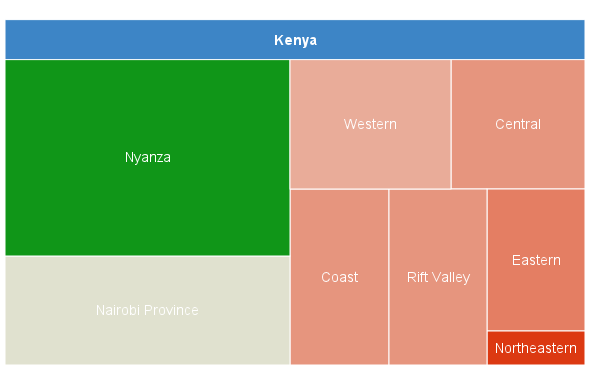
These are huge generalizations, and here's another one: HIV has been around for a long time, perhaps a hundred years, and it must have continued spreading from the epicenter (otherwise it would have died out). Sometimes the virus is depicted as a massive ‘explosion’ in the 1980s, but it had probably been spreading, albeit very slowly, in most countries in East and southern Africa for several decades before such explosive outbreaks occurred. Also, when they occurred, they did so in certain parts of countries; prevalence remained low in most parts of most countries, or else the period of very rapid increase occurred later. The tree graph of prevalence by county in Kenya (the percentage of people aged 15-49 infected with HIV), below, will have to serve as an example of a country with high levels of HIV in some areas but low levels in others (similar patterns are clear in many high prevalence countries, but not all).
Kenya prevalence tree graph
National prevalence is said to have peaked in the mid 1990s in Kenya, reaching a little over 10% before dropping at the end of the 90s and gradually settling at around half that figure in 2013. Prevalence in Uganda, in contrast, became high in the late 1980s to peak somewhere between 10 and 15% in the early 1990s. Therefore, Uganda’s epidemic is a bit older and a bit more severe than Kenya's. This may be because Uganda is closer to the epicenter of the epidemic, but there are probably also other reasons. Distance from the epicenter alone does not determine the eventual severity of an epidemic (prevalence in most west central African countries is lower than in most East and all southern African countries, for example).

In Kenya death rates probably peaked in the early 2000s. So, working backwards, if prevalence peaked in the mid to late 1990s, incidence (the annual rate of new infections) must have peaked several years before. A peak in the number of new infections would give rise to a peak in death rates about 10 years later, that being the average time someone infected with HIV would survive before dying from some AIDS related illness (and I must emphasize, these figures are rough).

So far, this is about a time that predates mass treatment for HIV. Treatment means that many HIV positive people can live a long time, perhaps as long as HIV negative people. However, few people would have been receiving treatment in African countries before well into the 2000s. The picture of Kenya’s epidemic is still grainy, but it should be clear that HIV spread far and wide over a longer period of time than some accounts suggest, and is probably close to 50 years old in the country (maybe plus or minus 10 years). More importantly, the picture is grainy because national prevalence figures suggest a fairly evenly spread epidemic, with a large sector of the population infected in each administrative or political unit.

But figures used to create the graph above, released a few months ago, allow us to bring the picture into better focus in Kenya (hopefully). The country recently went through various political changes that have resulted in the generation of prevalence figures for 47 counties, instead of the 8 provinces, which is all that was available previously. A quick look at some of these figures show just how blurred the picture was, for so long! (The graph below is prevalence by Kenyan province, the percentage of people aged 15-49 infected with HIV. If you compare these provincial level figures with the provincial figures for 2003, they are almost identical.)
Kenya prev provinces tree graph
The last graph is of the five Kenyan counties that border with Lake Victoria. Four of them are in Nyanza province and the fifth is in Western province, on the border with Uganda. Prevalence in Nyanza has remained around 15% for many years, with the highest figures in Homa Bay, Kisumu, Siaya and Migori and low rates in Busia. This graph is of numbers of people living with HIV in each county. But there is quite a range, with over 140,000 in Homa Bay and only 16,000 in Busia. There are more PLHs in Homa Bay than in the whole of Burundi (90,000). Also, there are more HIV positive people in Kenya than there are people in Swaziland.

Because more detailed figures are available now, but figures for earlier periods are hard to find, unreliable and not easy to compare with others, I’m starting the history at the end. How did an epidemic that began so far away, and such a long time ago, come to be as it appears now in Kenya? Prevalence in certain areas is lower than in some US cities. But in other areas it is as high as the three countries with ‘hyperendemic’ HIV, at well over 20% prevalence (Swaziland, Lesotho and Botswana).

The HIV industry that has developed around this lucrative disease continues to insist that the virus is transmitted almost entirely through heterosexual sex in African countries. This is despite the fact that it is mostly transmitted among men who have sex with men in the US (which has the highest number of people living with HIV outside of sub-Saharan Africa), injection drug being use a somewhat distant second mode of transmission in most western countries. Prevalence is low, even very low, among heterosexuals in most countries in the world, so why would it be high in certain parts of certain African countries? This is the central question for me. I believe that a history of the epidemic in Kenya will shed some light on how the virus infected, and continues to infect, so many people in some places and far fewer in others.

allvoices

Monday, August 4, 2014

Lessons from three previous Ebola outbreaks

[By Dr David Gisselquist - crossposted from the Don't Get Stuck With HIV site and blog.]

Newspapers, web, and TV have been delivering a crescendo of reports and comments on West Africa’s Ebola epidemic. A lot of what is available for public consumption scares people who are not at risk. At the same time, people at risk are not getting adequate advice from official sources to make informed decisions about how to protect themselves and their loved ones.

In this situation, it’s useful to take a look back at three well-studied and well-reported Ebola outbreaks: the first two recognized outbreaks in 1976 in Sudan and Zaire (currently Democratic Republic of the Congo) and a later outbreak in Kikwit, Zaire, in 1995. Official committees of experts studied each of these outbreaks and reported what they found in the Bulletin of the World Health Organization in 1978 and in the Journal of Infectious Diseases in 1999.

Nzara and Maridi, Sudan, 1976

The first recognized Ebola outbreak began in Southern Sudan in late June 1976 and ended in November 1976. A WHO/International Team coordinated a detailed and thorough investigation of the outbreak, reporting 284 cases and 151 deaths. Information and quotes in this and following paragraphs are from: Bulletin of the World Health Organization, 1978, pp 247-270, available at: http://whqlibdoc.who.int/bulletin/1978/Vol56-No2/ (accessed 2 August 2014).

The outbreak in Southern Sudan was traced to infections among workers at a cotton factory in Nzara town beginning in late June. The source of the virus is suspected to be bats or other animals living in the factory. During the outbreak, 9 factory workers got ill with Ebola (p 253); most subsequent infections came from household contact. “The outbreak in Nzara died out spontaneously” (p 254) after 31 deaths. 

Before the Nzara outbreak ended, cases from Nzara spread Ebola to two other communities, Tembura and Maridi. In Tembura, a woman from Nzara introduced Ebola that killed three close contacts; that was the end of it in Tembura. In Maridi, Ebola spread from two people from Nzara treated at Maridi’s hospital, which “served both as the focus and the amplifier of the infection” (p 252). Transmissions in Maridi lead to 116 deaths. Several patients from Maridi went for treatment in Juba, resulting in one additional infection and death among Juba’s hospital staff.

“The difference between the Nzara and the Maridi outbreaks is best exemplified by examining the focus where patients most probably became infected. Few patients (26%) were even hospitalized in Nzara, and they seldom stayed more than a few days, but in Maridi almost three-quarters of the patients were hospitalized, and often for more than two weeks. As a result, Maridi hospital was a common source of infection (46% of cases), whereas the Nzara hospital was not (3% of cases)…” (p 253).

A WHO/International Study Team arrived in Maridi towards the end of the epidemic and stayed to the end. The Study Team recruited surveillance teams to scout for cases in communities around Maridi. “A large number of cases of active infection were soon discovered; each was reported to the Sudanese officials and an ambulance accompanied by a Public Health Officer was sent to the house. Patients were persuaded to enter the isolation wards at the hospital” (p 250). Significantly, Public Health Officers did not force suspected cases to go to the hospital: “Some refused, and in these cases relatives were warned of the grave risks, and advised to restrict close contact with the patient, and to limit it to only one close relative or friend. Protective clothing was offered but usually refused.”

Yambuku, Zaire, 1976

The first recognized case reported symptoms on 1 September. The last death occurred just over two months later on 5 November 1976. An International Commission managed a detailed and thorough investigation of the outbreak, reporting 318 cases and 280 deaths. The information in this and following paragraphs is from the Bulletin of the World Health Organization, 1978, pp 271-293, available at: http://whqlibdoc.who.int/bulletin/1978/Vol56-No2/ (accessed 2 August 2014).

“The index case in this outbreak had onset of symptoms on 1 September 1976, five days after receiving an injection of chloroquine for presumptive malaria at the outpatient clinic at Yambuku Mission Hospital… [A]lmost all subsequent cases had either received injections at the hospital or had had close contact with another case. Most of these occurred during the first four weeks of the epidemic, after which time the hospital was closed, 11 of the 17 staff members having died of the disease…” (p 271).

“Five syringes and needles were issued to the nursing staff [at the Yambuku Mission Hospital] each morning for use at the outpatient department [with an average of 200-400 outpatients each day], the prenatal clinic, and the inpatient wards [with 120 beds]. These syringes and needles were apparently not sterilized between their use on different patients but rinsed in a pan of warm water. At the end of the day they were sometimes boiled” (p 273).

“The epidemic reached a peak during the fourth week, at which time the YMH [Yambuku Mission Hospital] was closed [on 3 October], then it receded over the next four weeks” (p 279). “[I]t seems likely that closure of YMH [Yambuku Mission Hospital] was the single event of greatest importance in the eventual termination of the outbreak” (p 280). The last recognized transmission occurred in late October.

The International Commission organized surveillance for cases in communities around Yambuku. “Suspect cases were not closely examined, but medicines were given to them and arrangements were made for their isolation in the village… [P]hysicians were sent to follow up suspect cases…” (p 276). Notably, surveillance teams did not force or even urge suspect cases to go to hospital. In any case, the outbreak in and near Yambuku had already died out on its own, with the last probable case dying on 5 November, four days before surveillance began on 9 November (p 277).

The International Commission collected and reported data on transmission from cases to family members. In 146 families with one or more cases acquired from outside the family, 1,103 family members were exposed, of which 62 (5.6%) got sick with Ebola (p 282). In other words, there was less than a 50% chance a case would infect a family member (146 cases, or more if any family had more than one case, infected a total of 62 family members). Thus, once the hospital closed, each case infected on average less than one family member, so the epidemic died out on its own.

Kikwit, Zaire, 1999

An International Scientific Commission investigated an Ebola outbreak in Kikwit, DRC, a large, sprawling town with a population reported at 200,000-400,000 at the time of the outbreak. The investigation identified 315 cases between 6 January and 16 July; out of 310 cases with adequate information, 250 died. Information in this and subsequent paragraphs is from a 1999 special issue of the Journal of Infectious Diseases, available at: http://jid.oxfordjournals.org/content/179/Supplement_1 (accessed 3 August).

During the Kikwit outbreak, 80% of case patients were hospitalized to treat their Ebola illness (page S82). However, hospitalization did not interrupt contacts between family members and case patients (p S88): “As in much of Africa, the families of inpatients are responsible for providing food and many other aspects of patient care, such as cleaning bedpans and washing soiled clothing and linens. Often family members arrange to sleep on the hospital ward [even sharing the patient’s bed; p S90] to assure continued care through the night.”

A study of secondary infections among 173 household members of 27 case patients found 28 secondary infections in 15 households (7 had >1 secondary case). “The exposure that was most strongly predictive of risk for secondary transmission was direct physical contact with the ill family member, either at home in the early phase of illness or during the hospitalization” (p S89). The 28 secondary cases occurred in 95 household members who had touched the case patient during early or late illness; whereas none of 78 household members who had not touched the patient at that time got sick, even though many slept in the same room, shared meals, or touched the patient before illness (p S89).

“There was an additional risk associated with a variety of exposures to patients in the terminal stages of illness, such as sharing a hospital bed or hospital meals and touching the cadaver” (p S90). “[T]he use of barrier precautions by household members and standard universal precautions in hospitals would have prevented the majority of infections and deaths…” (p S91).

During case surveillance in and around Kikwit town (p S78), “persons who met the case definition…were instructed to seek medical evaluation and possible hospitalization at Kikwit General Hospital…” However, this was not forced; if the sick person chose to stay home, family members “were educated on how to reduce their risk of infection…. Nurses previously trained in the sentinel clinics also visited household of probable case-patients to distribute protective materials (eg, a pair of gloves, soap, and wash basin) as needed and to reinforce educational messages about risks of transmission and symptoms suggesting disease in subsequent family members.” During surveillance outside Kikwit (p S78-S79), “Probable case-patients were confined in their households, instructions for care were given, and basic protective equipment was provided to the primary care givers.”

Lessons for West Africa, 2014

Based on reports from previous epidemics, here are several recommendations. The first is for people at risk to protect themselves. The second is for public health managers to deal with cases in a way that is acceptable to the community while at the same time ensuring transmission is too low to sustain the outbreak. Stopping the outbreak involves reducing the average transmission from each current case to less than one more case. Both recommendations contribute to that goal.

1. Recommendation to the public: If you are living in a community with Ebola cases, avoid injections, infusions, dental care, manicures, and all other skin-piercing procedures with instruments that might not have been sterilized after previous use. If you do this, and if you stay away from people with suspected Ebola infections, you have virtually no risk to get Ebola.

If someone stays away from sick people and funerals, the only remaining risk to get Ebola is through unrecognized contact with some unknown case. In previous epidemics, acquisition of Ebola from unrecognized contacts with unknown strangers has been confirmed through only one form of contact – blood-to-blood contact when health care workers reuse syringes and needles without sterilization to give injections to one patient after another. Reused, unsterilized skin-piercing equipment can pass Ebola from someone with the virus to complete strangers. If people in communities with Ebola avoid skin-piercing procedures – in hospitals, pharmacies, dental clinics, barbershops, beauty salons, from traditional healers, etc – the risk to get Ebola from some unknown source is near zero. Moreover, the public health risk – that people with Ebola will infect strangers not involved in patient care – will be too low to sustain the outbreak. (If you do go for an injection, manicure, or other skin-piercing procedure, you can ensure instruments used on you are sterile by following advice at: http://dontgetstuck.org/)

2. Recommendation to public health managers: Accept and accommodate home-based care of suspected and even confirmed cases, if that is what the family wants.

For the sake of effective management of the epidemic, the challenge is to reduce transmission on average from each case to less than one more case. Based on reports from three well-studied outbreaks in 1976 and 1995, caring for an Ebola case at home results on average in less than one new case – that is enough to wind down the epidemic, which is a lot better than what has been achieved so far in West Africa in recent months.

If a suspected case with common symptoms (fever, diarrhea, sore throat) goes to the Ebola ward, what is the chance he or she does not have Ebola? If so, what is the chance he or she will get Ebola from another patient? Without good data showing near zero risk for patients to get Ebola in an Ebola ward, it is reasonable for people to fear and resist going there. And, because getting all cases into isolation wards is not necessary to stop the epidemic (see previous paragraph), there is no good public health excuse for using government coercion to force people to go. Can we expect parents willingly to send children with sore throats to isolation wards?

The risk to family care-givers is, nevertheless, substantial if the suspected case turns out to have Ebola. If families accept the risk, that’s their choice. However, that risk can be reduced by giving care-givers detailed advice about specific risks, providing protective gear, and advising in-house quarantine measures to protect family members and others.

In any case, forcing suspected cases to go to isolation wards is likely to undermine rather than enhance epidemic control. Consider: When people are afraid government will force them or their loved ones to go to an Ebola ward, they may hide sick family members (suspected cases), avoid public health personnel, and seek secret treatment from cooperative doctors or others who may or may not practice barrier nursing or sterilize instruments after use. Thus, the threat of force may well reduce, not enhance, the ability of public health managers to advise and to supervise treatment of cases to prevent onward transmission.

This recommendation to accommodate home-based care agrees with a recent decision by Sierra Leone’s President Ernest Bai Koroma to quarantine sick patients at home, a decision appreciated by Heinz Feldman at the US National Institute of Allergy and Infectious Diseases: "It could be helpful for the government to have powers to isolate and quarantine people and it's certainly better than what's been done so far…" See: West African outbreak tops 700 deaths, Associated Press 31 July 2014, available at: http://www.patriotledger.com/article/ZZ/20140731/NEWS/140739987/12662/NEWS (accessed 31 July 2014).

Risks the current outbreak will spread to other countries

Are people living in the US or UK or Australia at risk? No. Just as in Maridi, Sudan, in 1976, the risk is that a patient with Ebola acquired elsewhere will go to a hospital with poor infection control, and that the hospital will amplify the infection, spreading it into the community. This is not going to happen in Europe, the US, or most other countries because hospitals with adequate infection control will not amplify the outbreak.

However, there is a risk that Ebola from West Africa’s ongoing outbreak might spread to other countries in Africa. Wherever HIV, a slow-acting bloodborne virus, transmits through unsafe healthcare, there is a risk that Ebola, with an incubation period of weeks not years, will similarly spread through unsafe healthcare. Most countries in Africa have generalized HIV epidemics, with more women than men infected, and with only small minorities of infections explained by men having sex with men or people injecting illegal drugs. The public health community likes to blame Africa’s generalized epidemics on sex, but no one has been able to find sexual differences between Africa vs. Europe or the US that could explain Africa’s generalized HIV epidemics. What is different is that Africans get more exposures to reused but unsterilized skin-piercing instruments during health care and cosmetic services.

The existence of generalized HIV epidemics in a country is best explained by a lot of HIV transmission through unsafe health care along with some sexual transmission. The fear that Ebola from West Africa might spread to other countries is a realistic concern for countries with generalized HIV epidemics.

allvoices

Saturday, August 2, 2014

South Africa: Don't Panic About Ebola, We Have Extremely Effective Surveillance Systems

Some may beg to differ with the health minister. While TB is very different from ebola, South Africans will (I hope) recall hearing about an epidemic of multidrug-resistant (MDR) and extensively drug resistant (XDR) TB being transmitted in health facilities in South Africa and surrounding countries, perhaps since the early 2000s. Scaremongering about infectious disease outbreaks doesn't do anyone any good, but nor does underestimating the ease with which diseases can spread, within a country and internationally.

A three decade HIV pandemic has shown us that surveillance systems on their own are not enough. The XDR/MDR epidemic is very closely connected with the HIV epidemic in South Africa and has been attributed to poor infection control. Countries that wish to control disease spread need strong health systems. However, the reaction to HIV has not been a sustained strengthening of health systems as a whole, but rather a vertical, cherry-picking approach. The result is that most countries in sub-Saharan Africa now have crumbling health systems, massive shortages in skilled health personnel, inadequate equipment and unreliable vital supplies.

Conditions are so dangerous that UNAIDS advises UN personnel not to use health facilities in developing countries, although the institution seems to believe that the same facilities are fine for Africans. Guinea, Liberia and Sierra Leone have relatively low HIV prevalence, whereas the number of HIV positive people in Nigeria could be the second highest in the world; South Africa is home to the highest population of HIV positive people. This has only weakened health systems further.

Nor is there any need to single out South Africa, Nigeria or the three countries that have the worst ebola outbreaks so far. There are Service Provision Assessments and other reports for many African countries showing that basic supplies such as gloves, soap and water, drugs, even injecting and other equipment, are frequently lacking. There are also scores of articles alluding to dangerous conditions, some published many years ago.

The South African health minister, and health ministers in all African countries, would be better off using outbreaks of ebola, MDR and XDR TB, hepatitis and HIV as arguments for investing in health systems that can provide safe health services for everyone, rather than for the rich alone, or for those suffering from headline grabbing diseases. Nosocomial TB in South Africa is thought to have started more than ten years ago, and affects many health facilities, in several countries. Therefore, there have been numerous outbreaks over that period, not just a few isolated instances.

Many of the people who have died of ebola are health professionals and others who are probably more aware of the risks they face than their patients are. Claiming that health systems are fine and that they are able to cope is a betrayal of the work their health professionals are doing. Minister Dr Aaron Motsoaledi should tell the WHO and other international institutions something that is an open secret about healthcare safety in African countries - it is in very urgent need of attention.

allvoices